Monday, February 14, 2011

Freescale QorIQ P4080 / XPedite 5470

QoriQ P4080 (P4 Series)

The QorIQ P4080 processor, the first product offered in the QorIQ P4 platform series, delivers industry leading performance in the under 30-watt power category. It combines eight Power Architecture™ e500mc cores – operating at frequencies up to 1.5 GHz – with high-performance datapath acceleration logic, and network and peripheral bus interfaces. All this designed for 45nm technology to deliver high-performance, next-generation networking services in a very low power envelope.

The QorIQ P4080 processor can be used for combined control, datapath, and application layer processing. Its high level of integration offers significant performance benefits compared to multiple discrete devices, while also greatly simplifying board design. The processor is well-suited for applications that are highly compute-intensive, I/O intensive, or both, making it ideal for applications such as enterprise and service provider routers, switches, base-station controllers radio network controllers (RNCs), longterm evolution (LTE) and general-purpose embedded computing systems in the networking, telecom/datacom, wireless infrastructure, military and aerospace markets.

Source - http://www.freescale.com/webapp/sps/site/prod_summary.jsp?code=P4080
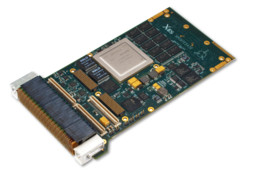
Extreme Engineering Solution XPedite 5470

The XPedite5470 is a high-performance 3U VPX-REDI single-board computer based on the Freescale P4080 processor. With eight PowerPC e500 cores running at up to 1.5 GHz, the P4080 delivers enhanced performance and efficiency for today's embedded computing applications.

The XPedite5470 supports two separate channels of up to 4 GB each of up to DDR3-1333 ECC SDRAM, as well as up to 16 GB of NAND flash and up to 256 MB of NOR flash (with redundancy). The XPedite5470 provides the option of utilizing a PCI Express or Serial RapidIO Fat Pipe P1 interconnect, as well as two SerDes Gigabit Ethernet Thin Pipe P1 fabric interconnects. The XPedite5470 also supports dual Gigabit Ethernet, GPIO, I²C, PMC I/O, XMC I/O, and up to two RS-232/RS-422/RS-485 serial ports through the P2 connector.

The XPedite5470 provides a ruggedized, high-performance, feature-rich solution to support the next generation of rugged embedded applications. Wind River VxWorks, QNX Neutrino, Linux, and Green Hills INTEGRITY Board Support Packages (BSPs) are available.

Source - http://www.xes-inc.com/Products/XPedite5470/XPedite5470.html

Monday, February 7, 2011

Altera Wants You...


Altera Corp want your opinions and input. Set up in 2010 the Altera Wiki was founded to provide a website for Altera users to contribute technical how-to articles and share their projects and IP with the community for all Altera related topics. The Altera Wiki complements the Altera Forum site. The Altera Forum is still the site to use for Question and Answer community help using thread discussions.


The Altera Wiki is a dynamic library of public articles that any and all can update and contribute. They have integrated the Nios Wiki into the Altera Wiki, including all pages and usernames. If you have any trouble accessing your account, please contact the Admin (wikiadmin 'at' alterawiki 'dot' com). To be a contributor to existing or create new article or project share, just register for a free account and sign in.


What is a WIKI?

A wiki is a collaborative Web site oriented to providing knowledge in a particular domain. Anyone can enter information, or change or comment on anyone else's contributions. A wiki website allows communities to easily create and edit web pages via a web browser using a WYSIWYG text editor or simplified language called wikitext.

Wikipedia definition: A wiki is a website that allows the easy creation and editing of any number of interlinked web pages via a web browser using a simplified markup language or a WYSIWYG text editor.Wikis are typically powered by wiki software and are often used to create collaborative wiki websites, to power community websites, for personal note taking, in corporate intranets, and in knowledge management systems.


SOURCE : Altera Wiki , See also - http://www.alteraforum.com/

Friday, February 4, 2011

MIL-STD-1553 Interfaces for Data Acquisition

MIL-STD-1553

Originally published by the U.S. Department of Defense (DOD) in 1973, MIL-STD-1553 is a military standard defining the mechanical, electrical, and functional characteristics of a serial data bus. Originally defined for military avionics, MIL-STD-1553 has become common in both military and civil spacecraft data handling subsystems.

DNx-553-1553: MIL-STD-1553 Interfaces The DNA-1553-553 and DNR-1553-553 are high-performance, two-channel MIL-STD-1553 interfaces for UEI’s popular “Cubes” and RACKtangle I/O chassis respectively. Each port operates fully independently and provides a complete dual, redundant 1553 interface and may be set as 1553a or 1553b. The “b” interface fully implements specification notices 1 and 2. Each port is transformer coupled, though direct coupling is available as an option.

Many 1553 functions are implemented in an on-board FPGA. This greatly reduces the burden placed on the chassis CPU and ensures the DNx-1553-553 does not interfere with the functionality of other I/O boards installed.

Each port may be independently configured as Bus Controller (BC), Remote Terminal (RT) or Bus Monitor (BM). As Bus Controller, the board supports all standard BC-RT, RT-BC and RT-RT transfers. The Remote Terminal support allows the board to emulate up to 31 different RTs on the bus. Bus Monitoring (BM) mode provides the ability to monitor all activity, or selective activity based upon RT address. In addition to monitoring data, BM monitors time tags, error status and RT response time. Finally, each DNA-1553-553 channel may be set to simultaneously act as an RT and BM or BC and BM.

MIL-STD-1553


MIL-STD-1553

When installed in the Cube, the DNA-1553-553 is well suited for the harsh environments sometimes encountered in flight testing applications. The board is specified for operation from -40° to +85° C, from 0 to 70,000 feet. The system is also fully tested for operation at 5g vibration and up to 50 g shock.
The DNx-1553-553 includes a standard MIL-1553 cable interface. Also included is a helpful, self-test loop-back adaptor.

The DNA/DNR-1553-553 includes our 1553 API, designed to offer simple, easy-to-use controls and yet maintain the ability to access all 1553 functionality. The software driver is compatible with all popular operating systems including Windows Vista and XP and Linux as well as most real-time OS’s such as RTX, QNX, RT Linux and more. Software support is also included for all popular programming languages and data acquisition (DAQ) application packages including LabVIEW and MATLAB.

SOURCE - http://www.ueidaq.com/mil-std-1553


UEI is a leader in the PC/Ethernet data acquisition and control, Data Logger/Recorder and Programmable Automation Controller (PAC) and Modbus TCP markets. Our revolutionary “Cube” form factor provides a compact, rugged platform, ideal for applications in the automotive, aerospace, petroleum/refining, simulation, semiconductor manufacturing, medical, HVAC, power generation and more.

The “Cube” is uniquely flexible, capable of being deployed as an Ethernet I/O slave, a standalone data logger, a standalone Linux-based PAC or a Modbus Slave. The “Cube” also offers incredible I/O flexibility, accommodating up to 6 I/O boards from a selection of over 25. This allows you to precisely match the I/O configuration to your application. With I/O interfaces for analog I/O, digital I/O, counter/timer, ARINC-429, quadrature encoder, CAN-bus, serial I/O and more, we are sure to have the interface you need.

Thursday, February 3, 2011

Altera's 28-nm Variable-Precision DSP Block Architecture Wins the 2011 DesignVision Award


Altera Corporation (NASDAQ: ALTR) has announced that its variable-precision digital signal processing (DSP) block architecture won the DesignCon 2011 DesignVision Award in the Semiconductor and IC category. Altera's variable-precision DSP block architecture was recognized by DesignVision Award judges for its ability to enable high-precision, high-performance digital signal processing in FPGAs that efficiently supports many different precision levels. This unique architecture is implemented within Altera's portfolio of 28-nm FPGAs to increase system performance, reduce power consumption and reduce architecture constraints for DSP algorithm designers. Altera was presented with the 2011 DesignVision Award at a ceremony held at the Santa Clara Convention Center during DesignCon 2011.


Altera developed the industry's first variable-precision DSP block architecture to meet the industry's demands for higher precision signal processing. This innovative architecture allows each DSP block in the FPGA to be configured at compile time to three 9x9, two 18x18 or a single 27x27 or 18x36 multiplier mode. Additional higher precision modes are available using multiple DSP blocks. This architecture supports, on a block-by-block basis, various precisions per block, ranging from low resolution fixed point video up to single-precision floating point within a single DSP block, and even double-precision floating point with minimal external logic. To learn more about Altera's variable-precision DSP block architecture, or to view a white paper or webcast on the architecture, visit www.altera.com/dsp-variable-precision.

SOURCE - Altera's 28-nm Variable-Precision DSP Block Architecture Wins the 2011 DesignVision Award

Has VME Learned From xTCA?

Altera Stratix® IV GX AdvancedMC from BittWare

Late in 2002, PICMG released the first version of the Advanced TeleCommunications Architecture (ATCA) standard. This defined the first true blade-based architecture, wherein all communication across the backplane was via a high-speed serial switch fabric, rather than over a shared, parallel, multidrop bus. This was followed by the Advanced Mezzanine Card (AMC) standard in 2005.

It didn’t take folks that long to realize that AMC cards could also be used as blades in smaller footprint systems. PICMG released the first version of the resultant MicroTCA standard in 2006. The advent of MicroTCA was seen as a positive development for the market, not only because of its technical capability and reduced footprint (vs. ATCA), but because it also expanded the potential market for AMC cards. These could be used either as mezzanine cards or as MicroTCA blades, yielding higher potential volumes and thus greater economies of manufacturing scale.

The VME industry was slower to adopt blade-based systems architectures, largely because military and aerospace defines the primary market for VME systems, and the military tends to take a more cautious approach to innovation than do civilian markets. In the latter, time-to-market is of overarching concern, whereas in military and aerospace, where mission criticality is the primary concern, far more emphasis is placed on reliability and ruggedness.

However, the evolution of VME through VME2eSST and VXS to VPX and OpenVPX has brought blade architectures, similar to ATCA, to the forefront of VME-based technology. It now appears that parallels to AMC and MicroTCA are also in the works.


Two new small form factor systems architectures are currently being investigated by VITA, with the objective of producing standards. These are “micro.VPX”and “NanoATR.” The former is the brainchild of PCI-Systems, Inc., and is the subject of working group VITA 73; it utilizes a small form factor VPX card. The latter, NanoATR, was developed by Themis Computer, targeted at ATR systems for aircraft, and utilizes an even smaller card. NanoATR is the subject of working group VITA 74. Both versions of the cards are being evaluated by the VITA 71 working group, which is developing a standard for a new rugged VME mezzanine architecture.

Source - VDC Research: Embedded Microprocessor, Board & Systems Market Blog

Wednesday, February 2, 2011

VPX & OpenVPX Technology from Extreme Engineering Solutions

VPX Rugged Boards from X-ES

X-ES is an industry and technology leader with regard to VPX and OpenVPX™. X-ES was actively involved in the development of the VPX and OpenVPX standardization efforts. X-ES was one of the first companies to develop VPX products and has been shipping VPX products since 2006.

VPX Specification

VPX (VITA 46), a module standard, was developed in support of ruggedized, deployed applications and is the technology of choice for ruggedized military applications where Size, Weight, and Power (SWaP) are an issue. VPX supports both 3U and 6U form factors, provides a large amount of high-speed I/O to the backplane, and enables the use of modules that require up to 200 watts of power.

VPX-REDI Specification

The Ruggedized Enhanced Design Implementation (REDI) laid out in VITA 48 defines how to implement cooling methodologies on specific board form factors. It supports enhanced forced-air cooling (using baffles and plenums), advanced conduction cooling (using larger and more efficient thermal interfaces), and liquid cooling. It also addresses the use of ESD covers on both sides of the board, a necessary feature for military two-level maintenance strategies.

OpenVPX™ Specification

OpenVPX™ (VITA 65) builds on the module-centric VPX specifications by providing a nomenclature of planes and profiles to enable system integrators, module designers, and backplane providers to effectively describe and define aspects and characteristics of a system. OpenVPX addresses major system interoperability issues while allowing for flexibility within the system, as enabled by its planes and flexible module profiles featuring user-defined I/O. By following a system-centric approach and defining a number of standard system topologies, OpenVPX enables interoperable off-the-shelf modules and development platforms within the VPX marketplace.

OpenVPX profiles make is easy to build development systems with compatible components. Deployable systems will always have system issues that need to be addressed, such as I/O, custom backplanes, power, and cooling. X-ES not only understands these issues, but has solved integration and system-level problems and delivered integrated VPX system solutions to customers.


X-ES provides a comprehensive line of 3U and 6U VPX products, including Intel®-based and PowerPC-based Single Board Computers (SBCs), carriers, switches, and I/O cards for embedded computing applications.

Because the environmental and SWaP constraints associated with rugged, deployed solutions complicate the design and integration of these systems, X-ES provides additional system-level components such as backplanes, power modules, development platforms, and deployable systems.

For more details and to view the range of VPX and OpenVPX products visit -
VPX and OpenVPX™ Technology - Extreme Engineering Solutions, Inc

Tuesday, February 1, 2011

Intel Sandy Bridge Processors & Embedded Computers

Intel Sandy Bridge

There has been a lot of talk regarding the "2nd generation Intel® Core™ processor family," previously known as Sandy Bridge. Some of the talk out there contains a bit of hype, but the reality is there are some major design changes to the processor in the Sandy Bridge architecture that will vastly improve single board computer, embedded motherboard and industrial computer system performance, power efficiencies and platform security.
Industrial computing solutions deployed in Mil-COTS defense applications, medical imaging and industrial automation systems are well suited to take full advantage of Sandy Bridge micro-architecture features. Trenton is hard at work developing a single processor system host board based on Sandy Bridge technology and expects to have evaluation units available by the end of Q1!

The way the processor sections on the Sandy Bridge CPU die have been re-ordered in this new architecture provides a tighter integration between the memory interface, processing cores and the traditional Northbridge functions. This is being argued as the first major, ground up x86 processor design since the Intel® Pentium® Pro was introduced back in the early '90s. That is the not Intel® hype per se, but in going though the re-ordering and re-structuring of the CPU die in Sandy Bridge, we can see validity of the claim that Sandy Bridge processors should provide a significant performance boost compared to the previous generation Westmere class of CPUs at a sharply reduced power consumption.

The Sandy Bridge architecture provides multiple processing cores with up to eight cores in the processor versions scheduled for release later this year and into the early part of next year. In addition to the processor cores, there is a separate graphics core and a new processor feature called Intel® AVX. AVX stands for Advanced Vector Extensions and it improves floating point computational speeds. A doubling of the vector widths to 256 bits and the ability to process partial width load and store operations also helps this AVX capability to boost performance.

Semiconductor Die Image

All of this gets combined with a new capability of applying Intel® Turbo Boost Technology across all cores; including the graphics core, to dynamically boost selected core processing frequencies based on the demands of the system at any given time. This should boost high-def video and 3-D graphics performance in video processing applications. One of the other improvements in Sandy Bridge is the ability to use these new processor architecture features to support multiple video and 3D graphic interfaces directly out of the processor.

Benchmark testing for our future board and system designs will confirm and quantify just how much of a performance boost to expect in your industrial computer applications using Sandy Bridge technology. Trenton's first Sandy Bridge-based SBC will be introduced next month and supports some interesting features such as dual video interfaces and a mini-PCI Express connector to support industry standard mini-PCIe cards. Stay tuned for future Trenton developments or give your Trenton account manager a call at 770.287.3100 or 800.875.6031 for additional information.

This submission is by Jim Renehan, Director of Marketing at Trenton Technology


SOURCE - Are Sandy Bridge Processors & Embedded Computers a Good Fit?