Tuesday, March 22, 2011

Xilinx : Zynq-7000 Extensible Processing Platform

Is this the new trend for 2011 - FPGA and Micro Processor going hand in hand?
This time its ARM and Xilinx.


The Zynq™-7000 family is Xilinx's first Extensible Processing Platform (EPP). This new class of product combines an industry-standard ARM® dual-core Cortex™-A9 MPCore™ processing system with Xilinx unified 28nm architecture. This processor-centric architecture offers the flexibility and scalability of an FPGA combined with ASIC-like performance and power and the ease of use of an ASSP.

The four devices of the Zynq-7000 EPP family allow designers to target cost sensitive as well as high-performance applications from a single platform using industry-standard tools. The tight integration of the processing system with programmable logic allows designers to build accelerators and peripherals to speed key functions by up to 10x. ARM architecture and ecosystem maximizes productivity and eases development for software and hardware developers.


http://www.xilinx.com/technology/roadmap/zynq7000/features.htm

SOURCE - Xilinx : Zynq-7000 Extensible Processing Platform

Friday, March 18, 2011

A Match Made in Silicon Heaven?

A configurable Intel Atom processor with an on-package Altera FPGA

I stumbled across this article the other day and it got me thinking about what a big partnership this is and what impact it will have on the embedded world.

E600 brings everything onboard for the platform, including PCI-E for using the E600 in a multitude of different capacities. Either bring your own PCH or build one yourself - Intel already showed examples of Realtek, OKI, and ST Microelectronics on stage. If you're just building a desktop, Intel has a fairly standard platform controller hub called the EG20T for control like ethernet, SATA and USB. Intel really hopes that their embedded Atom platform will bring cost of system integration way down.

Ok So its a new ATOM CPU so what?

When designing a microprocessor you have two options. For very complex designs you have a bunch of engineers come up with an architecture. They then spend countless hours, days, months, eons designing it, and doing layout and performance optimization. Photolithographic masks are made and handed off to a fab that produces the silicon on wafers. This is a great approach for microprocessors that have high complexity, performance and volume demands. If you have a simpler design and want to get it to market cheaper, there's another option: a FPGA.

A field programmable gate array is exactly what it sounds like, a whole bunch of gates on a die that can be programmed in the field. An FPGA can be made to function like pretty much whatever microprocessor design you program it to be. You shave off the initial manufacturing costs as you don't need to make expensive masks. FPGAs are often used in emulating larger microprocessor designs.


As Intel tries to take the Atom into the embedded space it may run into some customers that want to pair Atom with custom hardware. Intel could simply make a version of Atom for every single market vertical, however that would incur a significant cost overhead. 

Instead, in the first half of 2011 Intel will introduce the Stellarton processor. It's a configurable Intel Atom processor with an on-package Altera FPGA.

The theory sounds great but in practice this could be tricky device to integrate - don't you think?

SOURCE - AnandTech , SLASHGEAR, Intel

Friday, March 11, 2011

ZX81: Small black box of computing desire

ZX81

The Sinclair ZX81 was small, black with only 1K of memory, but 30 years ago it helped to spark a generation of programming wizards.

Packing a heady 1KB of RAM, you would have needed more than 50,000 of them to run Word or iTunes, but the ZX81 changed everything.

It didn't do colour, it didn't do sound, it didn't sync with your trendy Swap Shop style telephone, it didn't even have an off switch. But it brought computers into the home, over a million of them, and created a generation of software developers.

Before, computers had been giant expensive machines used by corporations and scientists - today, they are tiny machines made by giant corporations, with the power to make the miraculous routine. But in the gap between the two stood the ZX81.


SOURCE - BBC News - ZX81: Small black box of computing desire

Tuesday, March 1, 2011

Embedded World - 2011


The embedded world Exhibition&Conference is the world´s biggest exhibition of its kind and the meeting-place of the international embedded community. Embedded technologies are in action everywhere -whether in the car, data and telecommunication systems, industrial and consumer electronics, military systems or aerospace.


The embedded world Exhibition&Conference is the top get-together for the international embedded community. The exhibition set another record in 2010 with 730 exhibiting companies, and more than 18,000 trade visitors used the opportunity to obtain a comprehensive picture of the latest embedded technology trends.

Will you be going?
Are you already there?
What are you looking for at EW2011?

Visit the Exhibition Website - Embedded World

Monday, February 14, 2011

Freescale QorIQ P4080 / XPedite 5470

QoriQ P4080 (P4 Series)

The QorIQ P4080 processor, the first product offered in the QorIQ P4 platform series, delivers industry leading performance in the under 30-watt power category. It combines eight Power Architecture™ e500mc cores – operating at frequencies up to 1.5 GHz – with high-performance datapath acceleration logic, and network and peripheral bus interfaces. All this designed for 45nm technology to deliver high-performance, next-generation networking services in a very low power envelope.

The QorIQ P4080 processor can be used for combined control, datapath, and application layer processing. Its high level of integration offers significant performance benefits compared to multiple discrete devices, while also greatly simplifying board design. The processor is well-suited for applications that are highly compute-intensive, I/O intensive, or both, making it ideal for applications such as enterprise and service provider routers, switches, base-station controllers radio network controllers (RNCs), longterm evolution (LTE) and general-purpose embedded computing systems in the networking, telecom/datacom, wireless infrastructure, military and aerospace markets.

Source - http://www.freescale.com/webapp/sps/site/prod_summary.jsp?code=P4080

Extreme Engineering Solution XPedite 5470

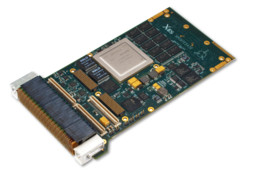
The XPedite5470 is a high-performance 3U VPX-REDI single-board computer based on the Freescale P4080 processor. With eight PowerPC e500 cores running at up to 1.5 GHz, the P4080 delivers enhanced performance and efficiency for today's embedded computing applications.

The XPedite5470 supports two separate channels of up to 4 GB each of up to DDR3-1333 ECC SDRAM, as well as up to 16 GB of NAND flash and up to 256 MB of NOR flash (with redundancy). The XPedite5470 provides the option of utilizing a PCI Express or Serial RapidIO Fat Pipe P1 interconnect, as well as two SerDes Gigabit Ethernet Thin Pipe P1 fabric interconnects. The XPedite5470 also supports dual Gigabit Ethernet, GPIO, I²C, PMC I/O, XMC I/O, and up to two RS-232/RS-422/RS-485 serial ports through the P2 connector.

The XPedite5470 provides a ruggedized, high-performance, feature-rich solution to support the next generation of rugged embedded applications. Wind River VxWorks, QNX Neutrino, Linux, and Green Hills INTEGRITY Board Support Packages (BSPs) are available.

Source - http://www.xes-inc.com/Products/XPedite5470/XPedite5470.html

Monday, February 7, 2011

Altera Wants You...


Altera Corp want your opinions and input. Set up in 2010 the Altera Wiki was founded to provide a website for Altera users to contribute technical how-to articles and share their projects and IP with the community for all Altera related topics. The Altera Wiki complements the Altera Forum site. The Altera Forum is still the site to use for Question and Answer community help using thread discussions.


The Altera Wiki is a dynamic library of public articles that any and all can update and contribute. They have integrated the Nios Wiki into the Altera Wiki, including all pages and usernames. If you have any trouble accessing your account, please contact the Admin (wikiadmin 'at' alterawiki 'dot' com). To be a contributor to existing or create new article or project share, just register for a free account and sign in.


What is a WIKI?

A wiki is a collaborative Web site oriented to providing knowledge in a particular domain. Anyone can enter information, or change or comment on anyone else's contributions. A wiki website allows communities to easily create and edit web pages via a web browser using a WYSIWYG text editor or simplified language called wikitext.

Wikipedia definition: A wiki is a website that allows the easy creation and editing of any number of interlinked web pages via a web browser using a simplified markup language or a WYSIWYG text editor.Wikis are typically powered by wiki software and are often used to create collaborative wiki websites, to power community websites, for personal note taking, in corporate intranets, and in knowledge management systems.


SOURCE : Altera Wiki , See also - http://www.alteraforum.com/

Friday, February 4, 2011

MIL-STD-1553 Interfaces for Data Acquisition

MIL-STD-1553

Originally published by the U.S. Department of Defense (DOD) in 1973, MIL-STD-1553 is a military standard defining the mechanical, electrical, and functional characteristics of a serial data bus. Originally defined for military avionics, MIL-STD-1553 has become common in both military and civil spacecraft data handling subsystems.

DNx-553-1553: MIL-STD-1553 Interfaces The DNA-1553-553 and DNR-1553-553 are high-performance, two-channel MIL-STD-1553 interfaces for UEI’s popular “Cubes” and RACKtangle I/O chassis respectively. Each port operates fully independently and provides a complete dual, redundant 1553 interface and may be set as 1553a or 1553b. The “b” interface fully implements specification notices 1 and 2. Each port is transformer coupled, though direct coupling is available as an option.

Many 1553 functions are implemented in an on-board FPGA. This greatly reduces the burden placed on the chassis CPU and ensures the DNx-1553-553 does not interfere with the functionality of other I/O boards installed.

Each port may be independently configured as Bus Controller (BC), Remote Terminal (RT) or Bus Monitor (BM). As Bus Controller, the board supports all standard BC-RT, RT-BC and RT-RT transfers. The Remote Terminal support allows the board to emulate up to 31 different RTs on the bus. Bus Monitoring (BM) mode provides the ability to monitor all activity, or selective activity based upon RT address. In addition to monitoring data, BM monitors time tags, error status and RT response time. Finally, each DNA-1553-553 channel may be set to simultaneously act as an RT and BM or BC and BM.

MIL-STD-1553


MIL-STD-1553

When installed in the Cube, the DNA-1553-553 is well suited for the harsh environments sometimes encountered in flight testing applications. The board is specified for operation from -40° to +85° C, from 0 to 70,000 feet. The system is also fully tested for operation at 5g vibration and up to 50 g shock.
The DNx-1553-553 includes a standard MIL-1553 cable interface. Also included is a helpful, self-test loop-back adaptor.

The DNA/DNR-1553-553 includes our 1553 API, designed to offer simple, easy-to-use controls and yet maintain the ability to access all 1553 functionality. The software driver is compatible with all popular operating systems including Windows Vista and XP and Linux as well as most real-time OS’s such as RTX, QNX, RT Linux and more. Software support is also included for all popular programming languages and data acquisition (DAQ) application packages including LabVIEW and MATLAB.

SOURCE - http://www.ueidaq.com/mil-std-1553


UEI is a leader in the PC/Ethernet data acquisition and control, Data Logger/Recorder and Programmable Automation Controller (PAC) and Modbus TCP markets. Our revolutionary “Cube” form factor provides a compact, rugged platform, ideal for applications in the automotive, aerospace, petroleum/refining, simulation, semiconductor manufacturing, medical, HVAC, power generation and more.

The “Cube” is uniquely flexible, capable of being deployed as an Ethernet I/O slave, a standalone data logger, a standalone Linux-based PAC or a Modbus Slave. The “Cube” also offers incredible I/O flexibility, accommodating up to 6 I/O boards from a selection of over 25. This allows you to precisely match the I/O configuration to your application. With I/O interfaces for analog I/O, digital I/O, counter/timer, ARINC-429, quadrature encoder, CAN-bus, serial I/O and more, we are sure to have the interface you need.